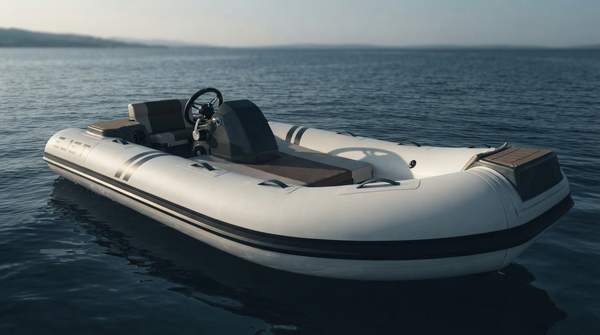
When a manufacturer claims its electric tender will do 23 knots or 100 nautical miles, the numbers are not the product of a single component. They are the output of a system in which hull weight, hydrodynamic shape, battery capacity, and motor power continuously constrain one another. Understanding that interplay—what we might call the Electric Tender Performance Triangle—is the single most useful skill for evaluating any electric yacht tender's design and performance claims. A powerful motor paired with a small battery, or a large battery dropped into a heavy, inefficient hull, produces predictable disappointment. The tenders that succeed are those in which every variable was chosen with the others in mind.
The Electric Tender Performance Triangle: A Systems Approach
The core insight, articulated clearly by Elco Motor Yachts in its guidance on electric boat propulsion, is that the motor alone does not determine whether a system will meet an owner's expectations. A powerful motor paired with insufficient battery capacity may not deliver the operating time needed; a large battery bank adds capacity but also weight and space requirements; and an inefficient hull may require considerably more energy to reach a desired speed. In other words, the three pillars—hull, battery, and motor—form a closed loop of trade-offs.
That is also how the builders themselves describe the work. Pascoe International, whose research into electric superyacht tenders spanned hull design, motor integration, battery technology, and system optimisation in collaboration with automotive electrification specialists, propeller designers, battery manufacturers, and university research teams, frames its zero-emission tenders as the product of that integrated research rather than of any single breakthrough. The lesson for the reader is direct: when a builder quotes range and speed, those figures reflect a bundle of interdependent choices, and each choice can be interrogated.
Hydrodynamics and Lightweight Hull Design
The first corner of the triangle is the hull, and it does double duty: its shape governs how much energy is needed to move through water, and its material governs how much of the boat's own weight must be moved along with the passengers. Elco's guidance notes that some hulls move efficiently at moderate speeds while others require considerably more power as speed increases—an observation that maps directly onto the tender's usable range at any given speed.
Material choice compounds this. OneTenders, a New Zealand builder of hand-crafted tenders, uses pre-preg autoclaved carbon fiber construction, an advanced composite process the company associates with high-performance engineering and exceptional structural efficiency, yielding boats it describes as remarkably light and strong. The significance for electric propulsion is architectural rather than cosmetic: every kilogram saved in the structure is a kilogram that does not have to be carried by the propulsion system or paid for in battery capacity. As Momentum Electric Marine puts it in describing the pairing of OneTenders hulls with its M-10 electric outboard, lightweight hull construction and lightweight propulsion work hand in hand to create a more responsive and efficient tender.
Battery Capacity and Weight: The Energy Storage Challenge
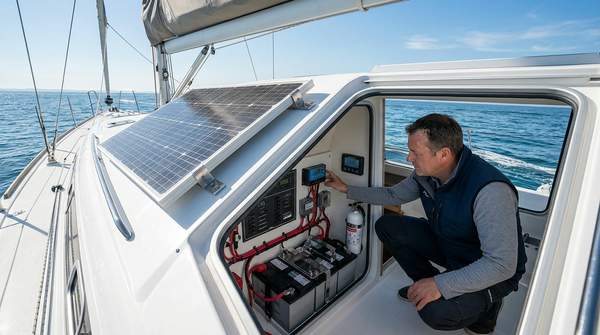
The battery is the tender's fuel tank, and unlike diesel, it cannot be refilled in minutes. Capacity is therefore the primary determinant of range—but capacity has mass, and mass has consequences. Elco's framing captures the bind precisely: a large battery bank adds capacity while also introducing additional weight and space requirements, and the propulsion system ultimately has to move everything onboard, not just the hull.
This is where hull efficiency and battery size meet. A lighter, more efficient hull needs less energy per nautical mile, so the same battery delivers more range—or the designer can hold range constant and spend the weight savings elsewhere, on passenger capacity or amenities. A heavier or draggier hull forces the opposite arithmetic: more battery to reach the same range, which adds weight, which demands more energy to move, which is the classic spiral electric designers work hard to avoid. Energy consumption also varies with speed and conditions, so a single range figure is always conditional on how the boat is actually run.
Motor Power and Efficiency: Translating Energy to Motion
The third corner is the motor, and here the temptation is to equate kilowatts with capability. Elco's guidance pushes back: the biggest motor is not automatically the best choice, because installing more available power does not eliminate the need to consider how much energy that power will consume when used. A properly sized system reflects the vessel's characteristics and the owner's performance expectations.
How the power is delivered matters as much as how much there is. Pascoe, which partnered with marine propulsion experts to create a drive system that optimises propulsion efficiency, highlights the electric drivetrain's inherent advantages—minimal torsional vibration, reduced noise inside and outside the cabin, and enhanced acceleration from electric motor torque. These are not just comfort features; a drive system that converts battery energy into thrust efficiently extends range at every speed, effectively enlarging the battery without adding a single cell.
The Electric Tender Performance Triangle
The framework below shows how the three pillars interact, and what each one trades against. Read any row alongside the others: a change in one cell forces a compensating decision in another.
| Design Aspect | Impact on Performance | Engineering Trade-off |
|---|---|---|
| Hull design & weight | Lightweight carbon-fiber construction (pre-preg autoclaved, per OneTenders) yields a light, strong hull; efficient hull forms need less power as speed rises. | Weight saved in structure can fund a larger battery for range, or stay as savings for speed and responsiveness. |
| Battery capacity & weight | Capacity is the primary determinant of range, but adds weight and space, and consumption varies with speed and conditions. | More range means more mass to propel; an efficient hull offsets this, an inefficient one amplifies it. |
| Motor power & efficiency | Right-sized motors match the hull and the owner's expectations; efficient drive systems reduce noise, vibration, and wasted energy. | More power consumes stored energy faster; oversized motors can shorten operating time rather than extend capability. |
The reasoning path is straightforward: start from the hull, because it sets the energy cost of every nautical mile; then size the battery against the intended mission's range; then select motor power that can deliver the target speed without draining that battery prematurely. Builders who skip a step—retrofitting a big motor into a heavy hull, or specifying range figures without stating speed—leave the triangle unbalanced.
Real-World Trade-offs: RS Pulse 63 vs. EJET 4X
Two current designs illustrate how differently the triangle can be resolved. The RS Pulse 63, reported by The Triton, was, in the words of Alex Middleton, head of electrical engineering at RS Electric Boats, "conceived and engineered as an electric boat from day one, not a conventional craft retrofitted with electric propulsion," with "every element of its design, from hull form to weight distribution, optimized for electric power." The result, per the manufacturer's claims, is a practical RIB delivering up to 100 nautical miles of range in ideal conditions and a 23-knot top speed, with a cathedral hull placing the battery low for stability and ride comfort.
The EJET 4X resolves the same triangle toward thrill rather than distance: 60 kW of continuous power, a 35-knot top speed, and a 45-mile range, positioned for quick runs and watersports, with jet propulsion for swimmer safety. The comparison is instructive. The EJET 4X's higher top speed comes with roughly a third of the Pulse 63's claimed range; the Pulse 63's range advantage comes with a lower top speed. Neither is superior in the abstract—each reflects a deliberate allocation of hull efficiency, battery capacity, and power toward a different mission. These figures are manufacturer claims reported by The Triton, not independently tested results, and the Pulse 63's range is explicitly conditional on ideal conditions.
Evaluating Electric Tender Performance: A Systems Perspective
When evaluating an electric yacht tender's performance claims, prioritize understanding the integrated design choices across hull weight, hydrodynamic efficiency, battery capacity, and motor power rather than focusing on individual component specifications in isolation. A quoted range or top speed means little until you know what it was traded against. The measurable indicator to apply is the consistency between a tender's stated purpose—long-range cruising versus high-speed transfers—and the engineering trade-offs evident in its hull material, battery size, and motor power specifications. A tender claiming both maximum speed and maximum range without a lightweight, purpose-built hull and a battery sized to match is making a claim the triangle does not support; one whose numbers align with its mission, like the range-focused Pulse 63 or the speed-focused EJET 4X, is showing you its engineering honestly.
Sources
- Understanding Electric Boat Propulsion: How It Works and Why It Matters — Elco Motor Yachts
- Luxury Electric Superyacht Tenders — Pascoe International
- OneTenders and Momentum Electric Outboard Motors Introduce a New Stand — Momentum Electric Marine
- The Rise of E-Tenders: Ready for Full-Time Duty? — THE TRITON