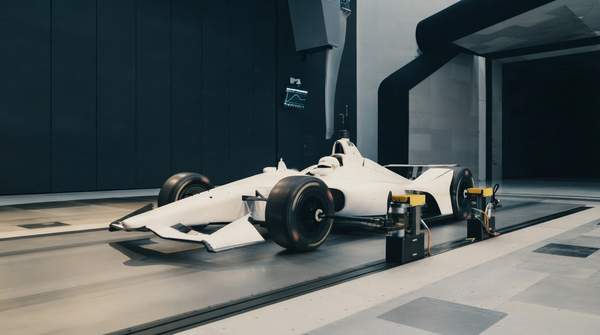
Modern supercar aerodynamics is built on a partnership between two very different tools: computational fluid dynamics, which simulates airflow around a vehicle entirely in software, and wind tunnel testing, which subjects a physical model or car to controlled airflow to generate experimentally validated data. Neither replaces the other. A research paper evaluating the two methods frames the relationship directly: CFD provides a virtual environment in which design changes can be iterated without the cost or time of physical prototyping, while wind tunnel testing produces the experimentally validated aerodynamic data a virtual model alone cannot guarantee. Manufacturers that ignore either half of that loop pay for it in lap time, stability, or wasted development budget.
Computational Fluid Dynamics (CFD): The Virtual Design Lab
CFD is, at its core, a numerical method. As the comparative research describes it, CFD models airflow around a vehicle computationally, letting engineers test a design on screen before a single carbon-fiber panel is molded. That speed is the tool's defining advantage: because each experiment lives in software rather than in a physical prototype, a team can explore far more design variations in the same calendar time than any fabrication schedule would allow.
McMurtry Automotive, the British company behind the Spéirling track car, states its own use of the method plainly. The company says it designs the Spéirling PURE in the virtual wind tunnel using CFD — language that captures how completely the digital environment has absorbed the early stages of aerodynamic development. Shapes, ducts, and surfaces can be reshaped, re-simulated, and discarded in hours rather than weeks.
But simulation has a structural weakness that no amount of computing power removes by itself. A NASA report on computational tools and testing draws the line precisely: validation, in its definition, is "the process of determining the degree to which a model or a simulation is an accurate representation of the real world from the perspective of the intended uses of the model or the simulation." A CFD result is, by that standard, a claim awaiting proof. Until it has been checked against physical reality, a beautifully rendered pressure map is still a prediction — which is why the wind tunnel exists.