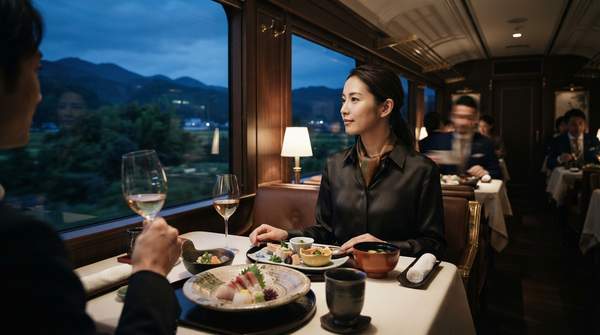
Food on a luxury train comes in two fundamentally different shapes. The first is the Gourmet Day Trip: a compressed, self-contained evening built around one meticulously prepared multi-course meal, in which the dining car itself is the destination. The second is the Multi-Day Culinary Expedition: a journey of several days and nights that treats the train as a moving thread connecting regional kitchens, breweries, and restaurants beyond the rails. Understanding which of these two models you are buying is the single most important step in choosing a culinary rail journey that matches your appetite.
Understanding Luxury Rail Culinary Journeys
Not every "fine dining" train experience means the same thing, and the marketing language tends to blur the differences. Two case studies make the distinction vivid. In California, the Napa Valley Wine Train runs a 36-mile round-trip from downtown Napa through wine country, with passengers dining on board as vintage rail cars glide past dozens of wineries, according to travel coverage of culinary train tours. Across the Pacific, Japan's Seven Stars in Kyushu—a train recently voted the world's best luxury train—offers a three-night, four-day itinerary explicitly designed around tasting the cuisine of Kyushu, both on the train and in the towns it visits.
These are not two versions of the same product. One delivers a single memorable meal within a fixed evening; the other weaves a sequence of meals, on and off the train, into a multi-day route. Once you see the two models side by side, you can classify almost any luxury train's culinary pitch.
The Gourmet Day Trip: A Culinary Excursion on Rails
The Gourmet Day Trip compresses everything into a single, choreographed dining event. Its defining traits are a fixed, short duration; a meal prepared entirely on board; and no dependence on what awaits beyond the station. The pleasure is self-contained: the kitchen, the courses, and the scenery passing outside the window are the whole itinerary. This model suits travelers who want a special-occasion dinner with a moving backdrop—an evening rather than a vacation. It also carries a practical advantage: the dining promise is precise. You know roughly how long the journey runs, how many courses you will be served, and that the experience does not hinge on excursions or external venues.
Case Study: Napa Valley Wine Train's Gourmet Express
The Napa Valley Wine Train's Gourmet Express dinner shows the model in detail. The operator's published itinerary runs like a script: the locomotive whistle sounds at 6:20 PM, a welcome splash of bubbly is poured as the train pulls forward, and by 6:30 PM dinner is under way. Over roughly two and a half hours, guests travel from Napa to Rutherford and back while enjoying three courses—described by the operator as including a roasted beet salad, red wine-braised beef short ribs, and a sweet or savory dessert course—before the train pulls back into its station at 8:45 PM.
The menu philosophy is seasonal and selective. Diners choose one item from each course, with first-course options such as today's soup, a roasted beet salad, or a prawn cocktail; mains that include grilled tenderloin of beef, seasonal risotto, pan-seared salmon, and ricotta cheese gnocchi; and desserts ranging from a sorbet trio to chocolate lava cake. Every meal, the operator notes, is prepared fresh in active kitchen cars while the train travels through wine country. The operator also flags two caveats worth repeating: menus change seasonally, and additional drinks are not included. For diners wanting more than a meal, the same railway offers a fuller itinerary, including a four-course meal on board plus winery tastings, per the travel coverage—evidence that even day-trip operators layer experiences upward.
The Multi-Day Culinary Expedition: An Immersive Gastronomic Adventure
The Multi-Day Culinary Expedition inverts almost every assumption of the day trip. Duration stretches from hours to nights, and the menu is not one chef's seasonal selection but a region itself. Dining is distributed across the itinerary—some meals on board, others at restaurants, breweries, and local venues the train pauses to visit. The result is closer to a culinary tour of a place, with the train as luxurious connective tissue. This model demands more commitment and typically more planning—the Seven Stars, for instance, fills berths through a lottery, according to the travel guide describing it. In exchange, the traveler gets variety, depth, and the narrative pleasure of a journey that unfolds across days, with each meal anchored to a specific stop or stretch of track.
Case Study: Seven Stars in Kyushu's Regional Delights
Seven Stars in Kyushu's three-night, four-day culinary tour is the clearest illustration. The itinerary circles the subtropical island of Kyushu, known for its lush natural beauty and volcanic landscape, and the dining program is deliberately regional rather than merely refined. As the travel guide describes it, the journey includes dinner at the French restaurant La Verveine, a carefully crafted bento-box lunch, and a special breakfast at the Murezuru Shuzo brewery featuring chicken soup and watadamai rice—a grain once eaten by local feudal lords in the Edo period.
Notice what makes this expedition distinct: the most memorable meals are not necessarily on the train at all. A brewery breakfast, a restaurant dinner, and a bento-box lunch are woven into a route whose purpose is to showcase the best of Kyushu's cuisine wherever it lives. That integration of off-train dining is the model's signature feature—and, for travelers who care about destination gastronomy, its principal draw.
Gourmet Day Trip vs. Multi-Day Culinary Expedition
The table below classifies the two trains into their representative models and compares them across the five features that matter most when evaluating a culinary rail journey. Use it as a template: apply the same dimensions to any train you are considering.
| Dimension | Gourmet Day Trip (Napa Valley Wine Train) | Multi-Day Culinary Expedition (Seven Stars in Kyushu) |
|---|---|---|
| Journey model | A round-trip journey designed around a single high-quality meal event | An extended gastronomic adventure integrating travel and diverse dining |
| Typical duration | Roughly 2.5 hours, evening round trip (Napa to Rutherford and back) | Three nights and four days circling Kyushu |
| Dining style | Three-course gourmet meal prepared fresh in the train's onboard kitchen cars | Regional specialties and multiple distinct meals, including a bento-box lunch |
| Menu philosophy / examples | Seasonal menu with choices per course—roasted beet salad, pan-seared salmon, red wine-braised beef short ribs, chocolate lava cake | Showcasing the best of Kyushu's cuisine—dinner at La Verveine, brewery breakfast with chicken soup and watadamai rice once eaten by Edo-period feudal lords |
| Off-train culinary integration | Self-contained on board; the meal and passing scenery are the entire experience | Core to the itinerary, with meals at an island brewery and a French restaurant along the route |
Reading across the rows, the essential divide emerges: the day trip concentrates excellence into one onboard kitchen and one evening, while the expedition disperses dining across a region and multiple days. Neither is a rank above the other; they answer different appetites. Both menus described here reflect seasonal or sample offerings that can change, so treat specifics as illustrations of philosophy rather than guarantees of your plate.
Selecting Your Ideal Luxury Rail Culinary Journey
Choose a Gourmet Day Trip for a focused, single-meal luxury dining experience or a Multi-Day Culinary Expedition for an immersive, extended gastronomic adventure with integrated on-board and off-train dining. Before booking any luxury train, ask four questions drawn from the comparison above: How long is the journey, and is that duration what you want? How many meals occur on board versus off the train? What is the menu philosophy—seasonal chef-driven courses, or a regional survey across venues? And is the food the destination or the companion to one?
The measurable indicator of a good match is the traveler's satisfaction with the journey's duration, the balance of on-board versus off-train dining, and the alignment of the menu philosophy with their culinary expectations. If a Gourmet Express-style evening leaves you wanting more of Kyushu-style depth, that mismatch is your signal to book the other model next.
Sources
- 5 Delectable Culinary Train Tours Around the World — Allianztravelinsurance
- Gourmet Express Dinner — Napa Valley Wine Train | Welcome Aboard The Wine Train