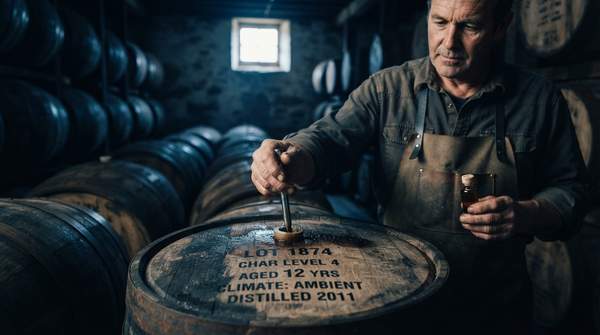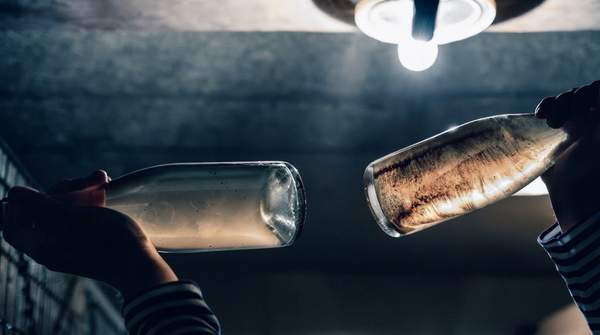
Ask why one whisky tastes of vanilla and coconut while another leans toward cedar and dried fruit, and the answer almost always begins with the barrel. Spirit aging is not passive storage; it is an active chemical exchange between the spirit, the wood, the oxygen slipping through the barrel, and whatever the cask held before. Distillers describe that exchange in three broad movements: subtractive processes that soften raw, harsh compounds; additive processes in which the wood contributes flavor and color; and interactive processes in which spirit, wood and oxygen react together to build new, more refined character. Understanding those movements turns a bottle label from marketing into a prediction.
Wood's Influence: American vs. French Oak
The additive side of aging begins with the wood itself, and the two dominant species used in traditional maturation—American oak and French oak—behave very differently. According to Distillery University's guide for craft distillers, American oak is known for its vanilla and coconut notes, while French oak provides more subtle tannins and spice. That difference is not accidental; it follows from the physical structure of the wood.
Beringer's winemaking education team breaks the contrast down further. American oak, sourced primarily from Missouri and Minnesota forests, has a wider grain, which accelerates flavor transfer; its typical profile is vanilla, coconut and sweet baking spice, producing bold, approachable flavors with a plush mouthfeel. French oak, from forests such as Allier, Limousin and Tronçais, has a tighter grain that slows flavor extraction, yielding subtle spice, cedar and refined tannins suited to elegance and layered complexity over long aging.
Horizon Beverage's account of barrel aging agrees on the sensory outcome: American oak gives a fuller, oaky, sweeter profile with hints of vanilla or caramel, while French oak gives more complex flavors with spice and more pronounced tannins. The same source adds a second variable the wood species alone doesn't capture—char. The inside of a barrel is burned to produce char, and the level matters: lightly charred wood is sweet and toasted, while heavily charred wood produces spicy, smoky flavors.
Barrel size shapes the pace of all of this. As Distillery University notes, smaller barrels accelerate aging because of a higher surface-area-to-volume ratio, while larger barrels offer slower, more controlled maturation. And climate sets the tempo: The Liquor Bros explain that Scotland's colder climate slows the chemical reactions between spirit and wood, which is why some Scotch whiskies age for decades, developing subtle, sophisticated layers rather than wood-driven flavors.
The Legacy of Previous Contents: Sherry and Wine Casks
A barrel's history is never fully rinsed out. Once a cask has held sherry, wine, port or rum, residual compounds from that earlier occupant remain in the wood, and a spirit laid into it afterward will pick them up. This is the finishing logic many distillers use for specialty releases: a secondary maturation in a used cask adds complexity that new wood alone cannot.
Distillery University describes used barrels as adding complexity "through residual flavors from previous aging cycles, such as bourbon, sherry, or wine," and notes that many distillers use port, sherry or wine barrels specifically to introduce unique finishing notes. The Liquor Bros are more concrete about the sensory result: barrels that previously held wine, sherry or rum add distinctive notes of dried fruit, sweetness, or baking spice to the final spirit.
Sherry casks, in practice, tend toward the darker, richer end of that range—dried fruit, nuttiness and warm spice—while ex-wine casks can push a spirit toward fruity, floral or sweet territory. One caveat deserves emphasis: the specific profile an ex-wine cask imparts depends on the type of wine the barrel previously held, so "wine cask finish" on a label is a category, not a single flavor. And because these are typical outcomes rather than guarantees, climate, aging duration and individual distillery practices all shift the final result.
Decoding Flavor: A Comparative Guide to Cask Types
Putting the two variables side by side shows how directly cask choice maps onto flavor. The table below consolidates what the sources above report for each cask type—the chemical contribution implied by the flavor notes each source describes, and the resulting profile a reader can expect. Read it as a prediction tool: given the cask, anticipate the flavor.
| Cask Variable | Specific Example | Key Chemical Contribution | Resulting Flavor Profile |
|---|---|---|---|
| Wood type | American oak (Missouri/Minnesota forests) | Wider grain accelerates flavor transfer; stronger extract contribution of vanilla- and coconut-associated compounds | Bold vanilla, coconut, sweet baking spice; fuller, sweeter, plush mouthfeel |
| Wood type | French oak (Allier, Limousin, Tronçais) | Tighter grain slows extraction; more tannic contribution | Subtle spice, cedar, refined tannins; elegant, layered complexity |
| Previous contents | Ex-sherry cask | Residual compounds from the sherry absorbed during secondary aging | Dried fruit, nuts, sweetness and baking spice; richer, darker finish |
| Previous contents | Ex-wine cask | Residual wine compounds, varying with the wine previously held | Fruity, floral or sweet notes; profile depends on prior wine type |
The pattern across the rows is consistent: wood type governs the baseline—sweet and bold versus tannic and subtle—while previous contents overlay a secondary signature. Char level and barrel size then modulate intensity and pace, from lightly charred sweetness to heavily charred smoke, and from fast small-cask extraction to slow large-cask patience.
Choosing Your Spirit: Understanding Cask Influence
When selecting a spirit, consider the cask type and its previous contents to anticipate its flavor profile. The label is the shortcut: producers typically specify the cask—"American Oak Aged," "Sherry Cask Finish," "French Oak"—and each phrase points to the characteristic profile in the table above. A bottle matured in American oak should lean toward vanilla and coconut; a sherry-finished one should show dried fruit and spice.
Two qualifications keep the prediction honest. These are typical results, and actual outcomes vary with climate, aging duration and specific distillery practices—The Liquor Bros note that even the same whiskey can differ batch to batch because of environmental factors, cask variation and warehouse position. And this framework covers the common casks, not every wood or finish in the industry. The measurable indicator is straightforward: check the label or producer's notes for the stated cask type, and use it to predict the flavor characteristics before you pour.
Sources
- The Art of Barrel Aging Spirits: A Guide for Craft Distillers — Distillery University
- Barrel Aging 101: French vs American Oak — Beringer
- History of Barrel Aging Spirits — Horizon Beverage
- How Aging Changes Whiskey Flavor — The Liquor Bros