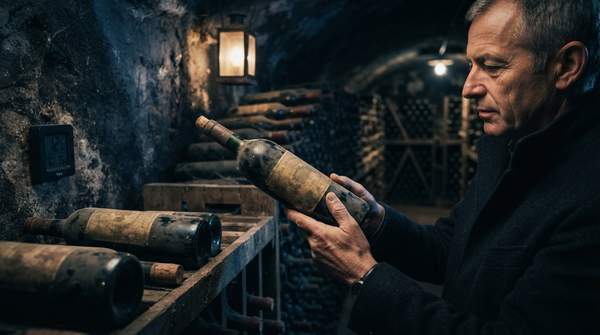
The science of wine aging comes down to one controlling variable: oxygen. Managed in tiny doses through the cork and the storage environment, oxygen drives the slow reactions that soften texture and build complexity; managed badly, it strips a wine of freshness. That is why collectors who want their bottles to develop rather than spoil aim for a cool, dark space held steadily between 55–60°F (13–15°C) with relative humidity of 60–70%, kept away from direct light. Consistency, more than any single perfect number, is what protects a wine's long-term development — and its value.
Establishing Optimal Wine Storage Conditions
Wine is chemically active long after it is bottled, and that activity is highly sensitive to its surroundings. Retailer and winery guidance alike converge on the same principle: environmental control is not cosmetic. Temperature, humidity, light, and vibration all shape how the wine develops over time, and deviations can accelerate aging past the point of quality or compromise the seal that protects the liquid at all.
The industry's summary prescription is simple and consistent across sources. Five Towns Wine & Liquor recommends a cool, dark environment with consistent temperatures between 55–60°F (13–15°C) and relative humidity of 60–70%, with bottles stored horizontally so the cork stays moist and oxidation is kept in check. Jessup Cellars frames the same conditions slightly more broadly — humidity of 50–70% — but the prescriptions otherwise align.
The chemical logic underneath is worth understanding, because it explains why these numbers matter. Writing on GuildSomm, importer Doug Polaner argues that a wine's aging ability starts with what is in the bottle — acid, tannin, sugar, and alcohol all play critical roles in longevity — and that "for a wine to age it has to be born in balance." An unbalanced wine, he notes, may be very acidic or very tannic at first, and "it takes time for the pieces to come together." Storage determines whether that assembly happens gracefully.
Oxygen is the mechanism connecting bottle to cellar. As SaratogaWine's overview explains, managing oxygen exposure is "the key to encouraging positive chemical reactions as well as preventing unwanted ones." Humidity governs how much oxygen gets in, because a cork shrinks as it dries, reducing its effectiveness as a closure; in barrel aging, dry wood shrinks too, letting oxygen slip between the staves. The right humidity keeps those seals tight and the oxygen dose controlled.
Temperature: The Pace Setter of Maturation
Temperature sets the speed of every reaction in the bottle. Higher temperatures accelerate aging — including the development of desirable flavors and aromas — while lower temperatures slow maturation dramatically, in Jessup Cellars' phrasing slowing "aging to a crawl" and preventing wines from reaching full potential. The winery warns that temperatures above 70°F (21°C) "develop cooked flavors and destroy fresh characteristics."
But the more consequential danger is instability. Fluctuations cause wine to expand and contract, potentially compromising cork seals and opening an uncontrolled path for oxygen. Jessup Cellars is explicit that consistency matters more than exact temperature, and Five Towns echoes this, cautioning against temperature swings that accelerate aging and compromise quality.
Practically, this reframes the collector's task. A cellar holding a rock-steady 58°F is in better shape than one that oscillates between 50°F and 65°F, even though both averages look similar on paper. The goal is a stable band inside the 55–60°F range — which is also, notably, the kind of environment Napa Valley's natural underground caves provide, and the reason many wineries age their wines there.
Humidity, Light, and Vibration: Protecting Your Investment
Humidity protects the seal. The 60–70% range recommended by Five Towns keeps corks from drying out and shrinking; SaratogaWine's account adds the mechanism — cork shrinkage reduces closure effectiveness and increases oxygen transfer into the bottle, accelerating reactions beyond the winemaker's intent. Too much moisture is its own problem, of course; balance matters on both sides of the range.
Light is a one-way constraint: less is better. Both Five Towns and the broader guidance point to dark storage with no direct light exposure, which minimizes the risk of light-induced degradation. Wine writer Kelli White, quoting a storage maxim in her GuildSomm essay — "absolutely no light, damp, and at the perfect temperature" — concludes that "storage conditions are the most important factor in a wine's ability to age."
Vibration appears across the sources as part of the standard prescription — Jessup Cellars lists minimal vibration among ideal cellar conditions alongside stable temperature, proper humidity, and light protection. However, none of the reviewed guidance documents a specific chemical mechanism or quantified threshold for vibration, so it is best treated as a generally accepted precaution rather than a precisely parameterized control. Professional storage facilities, which maintain all of these conditions consistently, are presented by Jessup Cellars as worthwhile investments for serious collectors.
Your Wine Storage Decision Framework
Use this matrix to audit your existing storage or to specify a new cellar. Each row links the environmental factor to its chemical rationale, the evidence-based control parameter, and the risk you accept by falling short.
| Environmental Factor | Scientific Rationale | Optimal Range / Practice | Risk of Non-Compliance |
|---|---|---|---|
| Temperature | Directly influences the rate of the chemical reactions that develop flavors and aromas. | Consistent 55–60°F (13–15°C); stability prioritized over the exact number. | Above 70°F (21°C), cooked flavors develop and fresh characteristics are destroyed; fluctuations cause expansion and contraction that can compromise cork seals. |
| Humidity | Governs cork moisture and therefore the rate of oxygen transfer into the bottle. | Relative humidity of 60–70% (one source allows 50–70%). | Dry corks shrink, weakening the seal and admitting excessive oxygen. |
| Light | Light exposure degrades wine in storage. | Dark environment; no direct sunlight or direct light exposure. | Light-induced degradation of the wine. |
| Vibration | Recommended as a precaution; no specific mechanism documented in the reviewed guidance. | Minimize vibration; store bottles horizontally to keep corks moist. | Not quantified in the sources; treat as standard practice for serious storage. |
Two caveats bound this framework. These figures are generally accepted industry standards, and specific wines may have unique requirements — the guidance covers principles, not vintage-by-vintage aging timelines. And this article addresses wine only; the chemistry of spirit maturation, which occurs in wood under different conditions, is a separate subject.
Ensuring Optimal Maturation for Your Collection
The decision is to implement and maintain a stable storage environment that adheres to recommended temperature, humidity, light, and vibration controls to protect and enhance your wine collection's long-term development. The chemistry rewards it: stable, moderate conditions keep oxygen entering at the slow, controlled rate that lets balanced wines assemble their components over years rather than collapsing into cooked, oxidized versions of themselves.
The measurable indicator is straightforward: consistent temperature readings between 55–60°F (13–15°C) and relative humidity of 60–70% within the storage area, coupled with the absence of direct light and vibrations. A thermometer and hygrometer that hold those bands over weeks — without oscillation — are the concrete evidence your cellar is doing its job. Where home conditions cannot hold steady, professional storage facilities, which maintain these parameters consistently, remain the fallback serious collectors use.