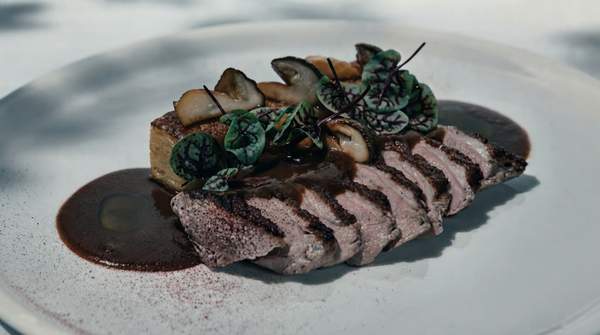
Why do some ingredient combinations sing while others clash? One influential answer comes from data, not tradition: the "food pairing hypothesis." A foundational study of the flavor compounds shared by culinary ingredients, published in 2011 by researchers building a "flavor network," found that Western cuisines tend to pair ingredients that share many flavor compounds—while East Asian cuisines tend to do the opposite, avoiding compound-sharing ingredients. Both approaches produce delicious food. Understanding this single contrast explains much of what happens on a Michelin-starred plate.
The Science of Flavor: An Introduction to Food Pairing
Every ingredient carries a chemical signature: a set of volatile and non-volatile compounds that together produce its characteristic taste and aroma. When researchers mapped these signatures across thousands of ingredients, they could ask a question cooks had only answered intuitively: do great recipes combine ingredients with overlapping chemistry, or with contrasting chemistry?
The answer, according to the flavor network study, is that it depends on where you look. Western cuisines show a clear tendency to use ingredient pairs that share many flavor compounds, a pattern that supports the food pairing hypothesis. East Asian cuisines show the opposite tendency. The study's authors describe their data-driven investigation as opening "new avenues towards a systematic understanding of culinary practice"—science catching up with what palates discovered over centuries.
The 'Food Pairing Hypothesis': Shared Compounds, Successful Combinations
The hypothesis itself is simple to state: ingredients that share key flavor compounds tend to pair well together. The flavor network study notes that this hypothesis "has been used to search for novel ingredient combinations and has prompted, for example, some contemporary restaurants to combine white chocolate and caviar, as they share trimethylamine and other flavor compounds, or chocolate and blue cheese that share at least 73 flavor compounds."
Those examples deserve a moment. White chocolate and caviar sounds absurd—until you learn both carry trimethylamine, the compound behind marine, briny aromas. Suddenly the pairing reads as chemistry, not gimmick. Chocolate and blue cheese, sharing at least 73 flavor compounds, follow the same logic: overlap creates harmony.
Yet the study's authors add a caution worth keeping: "the scientific analysis of any art, including the art of cooking, is unlikely to be capable of explaining every aspect of the artistic creativity involved." The hypothesis is a powerful tool, not a complete theory of deliciousness.
Contrasting Culinary Philosophies: Shared vs. Distinct Flavor Compounds
The most striking finding of the flavor network analysis is that two of the world's great culinary traditions succeed with opposing strategies. The table below contrasts them as the research describes them.
| Cuisine Style | Pairing Principle | Underlying Rationale |
|---|---|---|
| Western cuisines | Tend to use ingredient pairs that share many flavor compounds. | Supports the food pairing hypothesis: shared compounds lead to successful combinations. |
| East Asian cuisines | Tend to avoid ingredient pairs that share flavor compounds. | A contrasting approach that, as inferred from the observed avoidance of compound sharing, seeks diversity in chemical profiles rather than overlap. |
Read this as broad pattern, not rule: the analysis identifies tendencies across cuisines, and does not account for all regional or individual variations. But the framework is genuinely useful for the discerning diner. When a Western tasting menu pairs two ingredients that seem to echo each other—nutty with nutty, briny with briny—that is compound-sharing at work. When an East Asian dish layers ingredients that seem chemically unrelated, that contrast may be the point.
Molecular Gastronomy: Applying Science to Culinary Innovation
Where does molecular gastronomy fit? The Oxford Living Dictionary, cited in an overview of the field by the food science writers at Science Meets Food, defines it as "the application of scientific principles to the understanding and development of food preparation." Other definitions describe it as the scientific discipline studying the physical and chemical processes that occur during cooking.
That same overview characterizes the practice as applying scientific knowledge about ingredient interactions to modify and transform the texture and appearance of food—"creating unconventional flavor combinations that enhance your perception and liking of a food" and "surprising the consumer through unexpected tastes or temperatures."
Connect that to the flavor network, and the white chocolate–caviar plate stops being a stunt. The chef is not guessing; the chef is reading a shared molecule. This connection is a synthesis of the pairing hypothesis with molecular gastronomy's stated aims rather than a claim from any single source—but it is exactly the kind of reasoning the hypothesis was built to enable: a systematic search space for novel combinations.
The Future of Flavor: Informed Innovation
What should an epicurean take from all this? First, that deliciousness has testable structure: shared compounds genuinely predict many successful Western pairings, and their deliberate absence predicts many successful East Asian ones. Second, that the hypothesis has limits—it addresses shared compounds, not the full science of flavor perception such as texture and temperature, and it cannot explain every act of culinary creativity.
Discerning epicureans can appreciate innovative dishes by recognizing the scientific principles, like the food pairing hypothesis, that guide chefs in creating novel and surprising flavor combinations. The measurable indicator to watch is the continued emergence of unconventional yet harmonious ingredient pairings in high-end cuisine, often attributed to molecular gastronomy techniques. The next time a menu offers a pairing that makes you pause, ask the question the flavor network taught us to ask: what might these two ingredients share—or deliberately not share?