Gaetano Pesce, a visionary Italian designer, consistently challenged conventional design principles throughout his remarkable career by integrating experimental materials, distinctive sculptural forms, and profound social commentary into his work. His approach fundamentally rejects established norms of abstraction, uniformity, and homogeneity, instead embracing individuality and a "cross-contamination" between genres that, according to Friedman Benda, significantly altered the landscape of contemporary design and catalyzed the establishment of modern studio practice. Pesce's creations are often characterized by their vibrant colors, figurative expressions, and sometimes gelatinous textures, reflecting his belief that design should be pliable, immediate, and responsive to the contemporary world, as noted by Artspace Editors.
Pesce's commitment to using materials he considered authentic to the present moment, such as resin, foam, and urethane, allowed him to be sincere in his designs. He viewed materials from the past, like metal, marble, and stone, as "fake" because they no longer represented current reality, as he explained in an interview with Sight Unseen. This philosophy underpins his most iconic works, where material innovation is not merely a stylistic choice but is intrinsically linked to their sculptural expression and underlying critical messages, inviting users into a dialogue with their furniture.
UP5/La Mamma: Material Innovation and Feminist Commentary
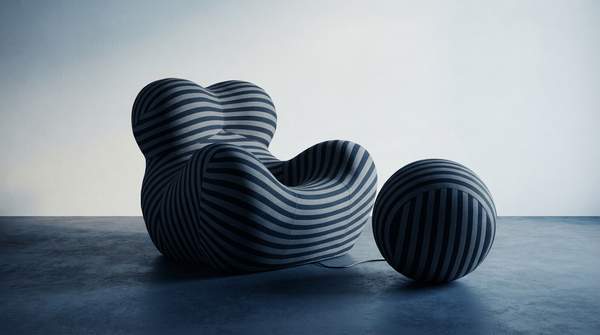
One of Gaetano Pesce's most iconic and politically charged creations is the UP5/La Mamma armchair, designed in 1969 for B&B Italia. This piece serves as a clear and powerful political statement, originally conceived by Pesce to resemble an ancient fertility figure, as Andrea Carson Barker notes for Azure Magazine. The chair, with its generous, rounded, and anthropomorphic shapes, is accompanied by a ball-shaped ottoman. Together, the chair and its attached ottoman function as a profound feminist statement, symbolizing the global condition of women and motherhood, with the ottoman representing societal constraints, akin to a ball and chain, according to Francesco Colbachini writing for Italian Design Club.
The UP5/La Mamma chair is ingeniously constructed from polyurethane foam and covered in elastic fabric. This innovative material choice allows the chair to be compressed and vacuum-packed for shipping, a revolutionary concept at the time. Upon opening, the chair slowly expands to regain its full, voluminous shape, embodying the pop-art spirit of its era through both its form and its interactive, almost performative, unboxing experience. The pliability and expansive nature of the polyurethane foam are crucial to both its distinctive sculptural form and its practical, transportable design, directly linking material properties to its conceptual message of liberation and expansion from constraint.
Feltri Chair: Redefining Comfort and Individuality with Industrial Felt
The Feltri chair, created in 1987, stands as a testament to Pesce's concept of "mass customization," a philosophy where each piece in a series is intended to be slightly different, allowing for individual expression. As Pesce discussed with Sight Unseen, this commitment ensures that each work feels like a unique gift. The chair is constructed from thick felt, a material typically associated with industrial applications, which is then stiffened with resin and bound together with hemp rope. This combination of robust, yet pliable, industrial materials allows for a unique sculptural form that challenges traditional notions of furniture construction.
The Feltri chair features a distinctive, flexible back that users can shape themselves, creating a personalized, cocoon-like form that adapts to their comfort and aesthetic preferences. This interactive element directly reflects Pesce's philosophy of inviting people into a dialogue with their furniture, allowing them to participate actively in the creation of a unique, individual piece. By empowering the user to customize their experience, the Feltri chair directly challenges the notion of standardized, uniform products, promoting individuality and a more personal connection between the user and the object. The stiffened felt, while providing structural integrity, retains enough flexibility to enable this user-driven customization, making the material choice integral to the chair's conceptual message.
Il Giullare Sofa: Playful Forms and the Rejection of Uniformity
The Il Giullare Sofa, designed for Meritalia in 2012, takes its name from the Italian word for "jester," referencing the jester's distinctive hat. This sectional sofa is characterized by its playful, non-uniform, and overtly asymmetrical form, with each element varying significantly in shape and color, as described by Andrea Carson Barker for Azure Magazine. It is composed of a diverse array of materials, including polyurethane foam, wood, and fabric, with each component contributing to its distinct, almost whimsical, appearance. This deliberate variation in materials and forms directly embodies Pesce's rejection of conventional design principles that prioritize uniformity and rigid structure.
The sofa's design incorporates thoughtfully placed fabric tongues that extend from the back, functioning as movable cushions that can be adjusted for comfort, much like an arm around the shoulders. These unusual and adaptable elements actively encourage users to modify them, fostering a personalized and interactive experience. The Il Giullare Sofa thus serves as a powerful commentary on the rejection of conventional design principles and the pursuit of individuality over homogeneity. Its playful aesthetic and user-adjustable features invite a dialogue, allowing the furniture to communicate with people through its recognizable, yet unconventional, forms, as Pesce noted in an interview with Sight Unseen, where he emphasized the importance of forms that "talk to people."
Six Tables On Water: Resin's Fluidity and Environmental Reflection
The "Six Tables On Water" series highlights the critical and transformative role of material in Gaetano Pesce's work, particularly his innovative use of poured resin. Pesce considers resin superior to glass due to its inherent pliability and immediacy, qualities that allow for direct and expressive creation, as Artspace Editors report. This contemporary approach to materials captures Pesce's essence, as he consistently rejected the "tyranny of the ordered, clean lines of architectural modernity" in favor of more figurative and fluid forms. The ability to work with resin today and have the piece ready tomorrow aligns with his desire for materials that represent the current reality, unlike traditional materials from the past.
In this series, the resin is manipulated to appear as if it flows, forming spaghetti-like filaments and adorning the pieces with an intricate interplay of opacity and transparency, reminiscent of natural elements, particularly water. The creative possibilities of resin, combined with a range of intense colors, allow Pesce to mimic the fluidity and dynamic nature of water, evoking environmental themes and reflecting on the natural world. These tables exemplify how Pesce leverages the unique properties of experimental materials to create figurative forms that not only challenge conventional aesthetics but also offer a profound commentary on the environment and the expressive potential of contemporary materials. The "gelatinous" quality often associated with his work is particularly evident here, transforming an industrial material into an organic, evocative sculpture.
Conclusion: Pesce's Enduring Legacy of Material and Meaning
Across iconic works such as the UP5/La Mamma chair, Feltri chair, Il Giullare Sofa, and "Six Tables On Water," Gaetano Pesce consistently demonstrated a radical and cohesive approach to design. He leveraged experimental materials like polyurethane foam, stiffened felt, and poured resin to enable distinctive sculptural forms that defied conventional aesthetics and challenged established norms of abstraction, uniformity, and homogeneity. These material and formal innovations were not merely stylistic choices but served as integral vehicles for profound social commentary and the embodiment of his unique design philosophies.
From the powerful feminist statement embedded in the anthropomorphic UP5/La Mamma, symbolizing women's condition and societal constraints, to the concept of "mass customization" championed by the user-interactive Feltri chair, and the playful rejection of uniformity in the asymmetrical Il Giullare Sofa, Pesce's designs consistently invite dialogue and interaction. His "Six Tables On Water" further illustrate his ability to transform industrial materials into evocative, nature-inspired forms, reflecting on environmental themes and the fluidity of the contemporary world. Pesce's enduring legacy lies in his unwavering commitment to challenging established design norms, proving that furniture can be both deeply personal and universally resonant, continually pushing the boundaries of what design can be and what it can communicate about the human condition and our relationship with materials.
Sources
- Discover Gaetano Pesce in five stops - The Spaces — The Spaces
- GAETANO PESCE: AGE OF CONTAMINATIONS – Friedman Benda — Friedmanbenda
- Gaetano Pesce on Art, Life, & Everything In Between — Phaidon
- Gaetano Pesce Influenced the Current Generation of Designers More Than Anyone We Know - Sight Unseen — Sight Unseen
- 7 iconic works by designer Gaetano Pesce | Luxus Magazine — Luxus Magazine
- 5 Iconic Designs by Gaetano Pesce — Azure Magazine
- Gaetano Pesce: A Master of Design and Architecture - Italian Design Club — Italian Design Club